eCoC XML Requirements for Manufacturers: What Must Be Controlled Before Submission
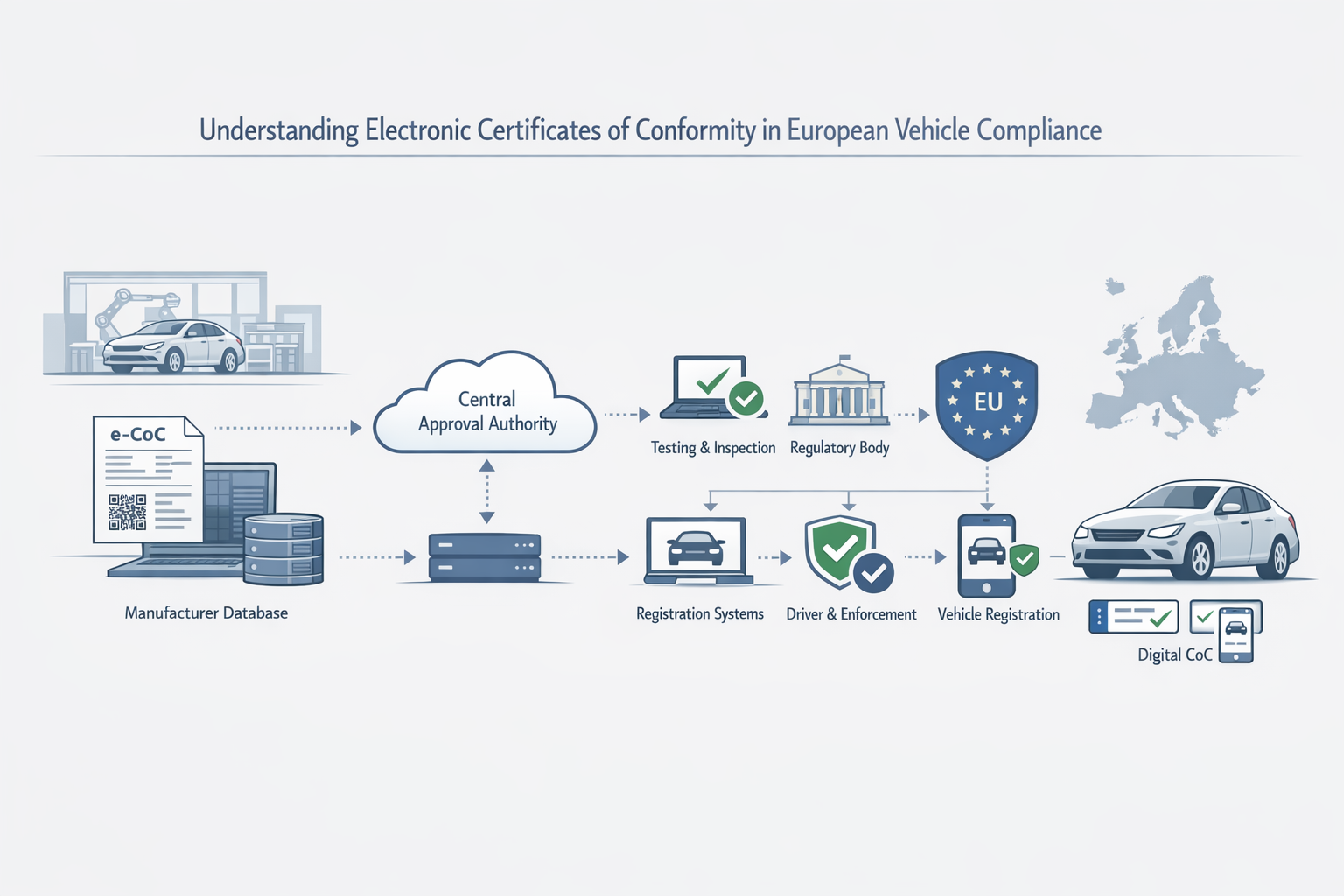
When teams discuss electronic CoC readiness, the conversation often jumps straight to XML generation. That is understandable because XML is the visible technical format of the output. But manufacturers do not succeed with eCoC by thinking about XML as a formatting step alone. They succeed by controlling the data, references and release logic that make the XML trustworthy before submission.
In other words, XML requirements are not just about tags, fields and schema validation. They are also about approval traceability, vehicle identity, consistency between systems and confidence that the final electronic message still represents the approved technical configuration.
Why XML Requirements Start with Regulatory Truth
Any structured eCoC message is only as reliable as the regulatory record behind it. If the underlying approval references are outdated, if technical values differ between systems or if ownership of key attributes is unclear, even a well-formed XML message can become operationally risky. Manufacturers therefore need to treat XML preparation as the final expression of a controlled regulatory dataset, not as the place where inconsistencies are solved.
This is why the most important XML requirement is often not a syntactic rule. It is the ability to prove that the submitted data still maps back to the approved vehicle type and the current controlled source of truth.
The Core Data Domains Behind eCoC XML
Manufacturers typically need to control several domains before XML generation becomes reliable. The first is vehicle identity: which record describes the vehicle type and which fields distinguish one configuration from another. The second is approval references: the formal links to the approved technical basis. The third is parameter quality: whether the technical characteristics used in the XML are complete, current and aligned across systems.
When those domains are governed separately, XML generation becomes harder because the final message has to reconcile too many disconnected sources. The stronger model is to align them earlier so the XML output reflects one validated record instead of a late-stage compilation exercise.
Validation Before Submission
Manufacturers should expect more than one validation layer. Field-level validation checks whether values are present and correctly structured. Relationship validation checks whether fields remain logically consistent with one another. Approval validation checks whether the output still matches the approved technical configuration. Workflow validation checks whether the required review and release steps were completed before submission.
These layers matter because XML messages can fail operationally for reasons that do not show up in a simple schema check. A valid file can still be built from inconsistent approval data. That is why submission readiness should be based on business and regulatory validation as well as technical validation.
How IVI Supports XML Readiness
IVI structures are relevant here because they help manufacturers maintain machine-readable regulatory records before the eCoC output is assembled. When IVI quality is weak, XML preparation becomes more manual and error-prone. When IVI quality is strong, the path from approved data to final eCoC output is more stable and easier to validate.
That makes IVI an upstream dependency of XML readiness rather than a separate technical topic. Teams that improve IVI governance usually improve eCoC XML quality at the same time.
Common Manufacturer Gaps
One common gap is late data collection. If the final XML depends on spreadsheets, manual lookups or ad hoc corrections near release day, the process is unlikely to scale. Another gap is weak role definition. When no one clearly owns the approved values, the XML output may change without a controlled decision path. A third gap is incomplete review logic. If the organization cannot show which checkpoints were completed before submission, it becomes difficult to defend the reliability of the message.
These gaps are not unusual, but they are exactly why structured pre-submission control is necessary. XML readiness is as much an operational discipline as a technical one.
What Manufacturers Should Standardize
Manufacturers preparing for eCoC XML submissions should standardize source ownership, approval reference handling, validation rules and release responsibilities. They should also define when an output is considered ready and which changes require renewed review. Once those rules are stable, technical generation becomes more predictable and submission risk falls.
The broader lesson is simple: successful XML submission depends on governed inputs. The format matters, but the operating model behind the format matters more.
Frequently Asked Questions
Are XML requirements only technical?
No. They also include approval alignment, data quality, ownership and release controls.
Why is validation needed before submission?
Because a technically valid XML message can still be based on inconsistent regulatory data.
Which upstream topic is most connected to eCoC XML quality?
IVI data quality is one of the strongest upstream factors because it influences how reliably approved values are carried into the final output.