eCoC vs CoC: What Changes for Vehicle Manufacturers?
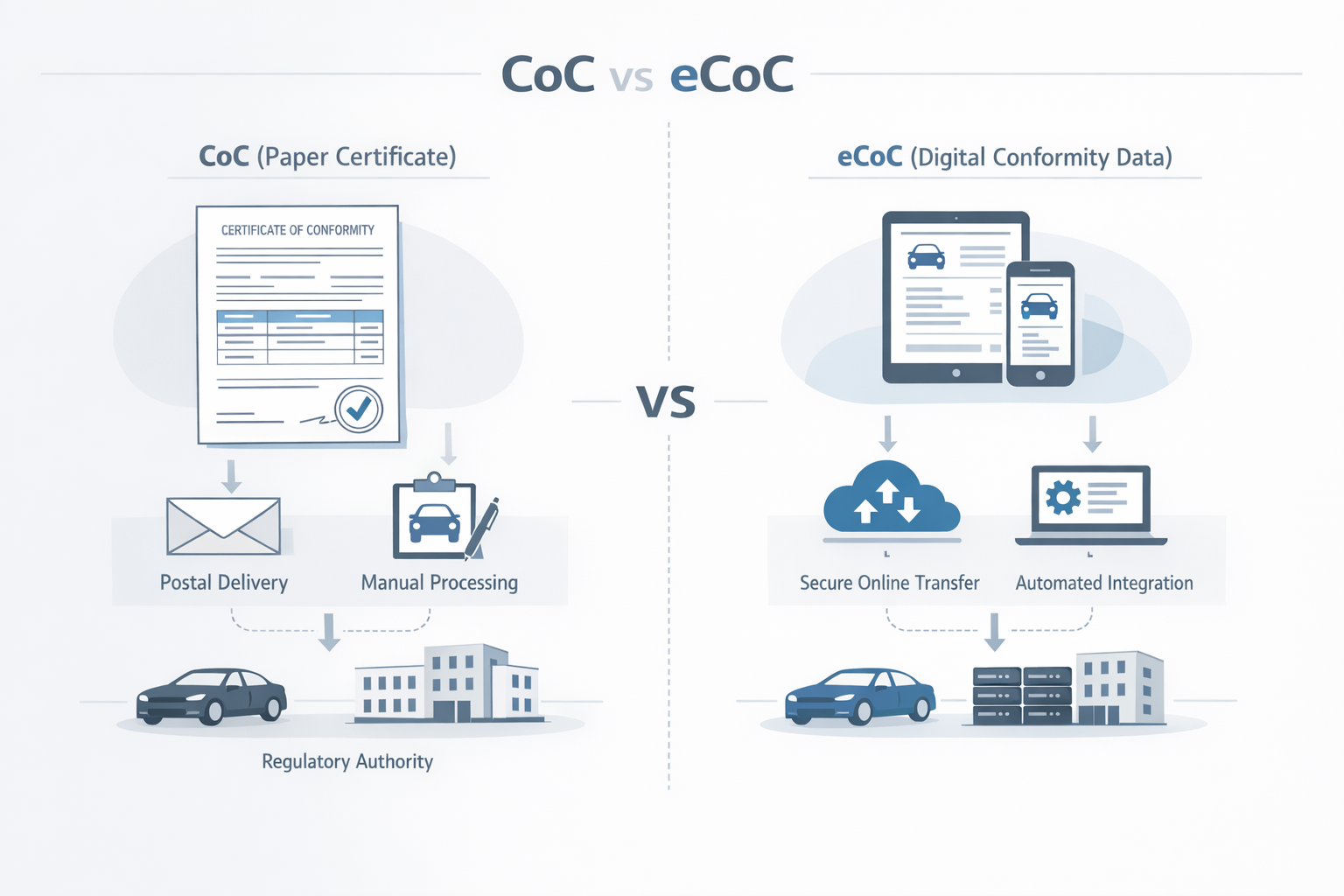
CoC means Certificate of Conformity: the manufacturer’s statement that an individual vehicle conforms to the applicable approved type. An eCoC represents conformity information as structured electronic data. In this comparison, paper CoC refers to the human-readable certificate and eCoC to the electronic record prepared for the relevant receiving service. Both depend on accurate information about the same vehicle.
Paper CoC and eCoC at a glance
| Review point | Paper CoC | Structured eCoC |
|---|
| Representation | A certificate arranged for people to read. | Defined data fields that receiving systems can process. |
|---|
| Preparation checks | Vehicle values, applicable layout and release review. | Vehicle values, message structure and receiving-service rules. |
|---|
| Delivery evidence | The issued version and the applicable delivery record. | The submitted artifact, attempt reference and returned status. |
|---|
| Correction control | Identify the corrected certificate and its source. | Identify the corrected dataset and follow the receiver’s process. |
|---|
The table is a practical workflow comparison. It does not mean that every paper certificate or receiving service uses identical checks. Establish the requirements for the particular vehicle scope before implementing the process, especially where more than one country, approval route or manufacturing stage is involved.
Why a PDF or scan is not the structured record
A scanned certificate preserves an image of a document. An XML record provides named fields and relationships that software can inspect. Reading values from a PDF can be part of data preparation, but the result still needs review against the approved source and the required message specification. OCR or manual transcription should not silently become the authoritative technical record.
For example, a mass value may be legible in a scan while its unit, applicable configuration or source revision remains unclear. Before mapping it into an electronic field, resolve those questions. The same applies to decimal separators, optional equipment and references copied from an earlier certificate. A successful file conversion says little about whether the record describes the intended vehicle.
Start both outputs from the same controlled data
Maintain a vehicle record that connects the VIN, applicable approval reference and relevant technical characteristics. Where paper and electronic outputs are both needed, compare them against that shared source. Do not let corrections accumulate separately in a document template and an XML export. Otherwise, two apparently valid outputs may gradually describe different configurations.
A useful pilot is to choose one ordinary production vehicle and one more complex case. Trace a small set of important fields from their source through both outputs. Include a value that requires formatting or unit conversion. Record the transformation explicitly so that another reviewer can repeat the check without relying on the person who built the template.
Electronic release adds validation, signing and response review
For eCoC, prepare the message required by the selected receiving route, run the applicable checks, apply the required signature or seal and retain the submitted file. RDW’s electronic submission information is one authority-specific starting point. Requirements from one service should not be assumed to describe every other channel.
IVI XML validation checks the output against the selected rules; it does not establish every fact about the physical vehicle. The XML signing step must then be configured for the intended route. Preserve the exact signed artifact and inspect the returned response before assigning a final status to the submission.
Does electronic delivery remove every paper requirement?
Check the current scope for the receiving authority and vehicle category. For example, RDW’s guidance reviewed on 3 October 2026 identifies 29 November 2026 as the production-date threshold for mandatory digital CoC for M, N and O vehicles, with national small-series exceptions. This is scoped Dutch registration guidance, not a claim that every paper document disappears everywhere.
How to handle a mismatch or rejected submission
If the electronic output disagrees with a paper certificate, identify which source and revision produced each one. Correct the controlled source or mapping responsible for the discrepancy, then regenerate and review the affected output. Keep the earlier artifact and reason for correction available according to the applicable retention arrangements.
If the receiving service rejects a record, distinguish data, signing, account and transport problems before retrying. Follow its correction and duplicate-handling process. The NAP submission workflow explains this manufacturer-facing handover. Electronic COC Platform connects creation, validation, signing, configured NAP submission and response tracking so operators can follow each step against the vehicle record.